Not all eco paints are created equal, and not every wall needs the same solution. Between green labels, marketing promises and mineral products with centuries of use in Portugal, choosing well requires understanding the difference between a serious certification and a simple adjective on the packaging.
Mineral paints: lime, clay and silicate
Lime paint: the most traditional
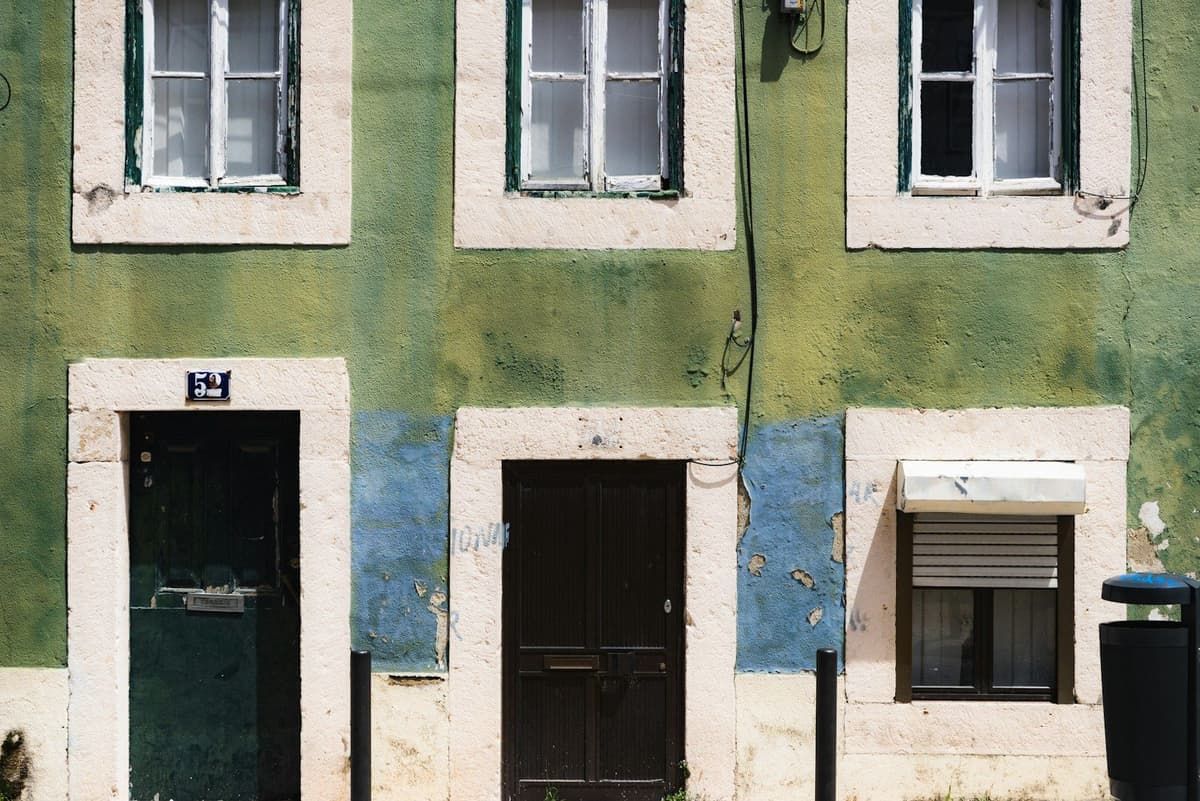
Lime is one of the oldest materials used in Portuguese construction, especially in historic city centres like Porto, classified as a UNESCO World Heritage Site, where lime, stone and wood remain the dominant materials on old facades. In Porto, in the period before reinforced concrete, the most common materials in built heritage are stone, wood, lime, ceramics and glass1. Lime-based paint has a relevant technical advantage: it is naturally resistant to fungi and allows the wall to release accumulated moisture, rather than trapping it.
Clay paint: indoor comfort
Clay paint, also called earth paint, is used mainly in interior rooms. Among its characteristics, water vapour permeability and the absence of volatile organic compounds stand out, as it is tested by the Eco-Institut, made of natural and ecological raw materials, with no emissions (zero VOC) and open pore. It is a common choice in bedrooms and living rooms where a more stable environment in terms of relative humidity is sought.
Silicate paint: durability on facades
For exteriors, mineral paint based on potassium silicate is often recommended in the restoration of old buildings. This type of paint forms a chemical bond with the mineral substrate, promoting the consolidation of mineral substrates and offering excellent water vapour permeability, while being water-repellent and resistant to fungi and algae2. This is why brands like Robbialac position this type of product specifically for the restoration of historic facades, where the aim is to reproduce the effect of traditional mineral paints.
How to interpret eco certifications
The European Union Ecolabel
In Portugal, this is one of the most reliable seals for those seeking paints with lower environmental impact. It is a comprehensive certification that goes far beyond the presence of hazardous chemicals, ensuring that a given product has a lower environmental impact and high quality and effectiveness. Recently, the European Commission updated the criteria applicable specifically to paints and varnishes, with an updated reference for awarding the EU Ecolabel, with strengthened focus on environmental performance throughout the life cycle3, which makes this seal even more demanding from now on.
What is not enough to be called "eco"
Water-based paint is not automatically sustainable. It is necessary to evaluate all the ingredients, not just the solvent used. It is worth checking:
- Whether the packaging displays a recognised seal (European Ecolabel, for example) and not just generic text
- Whether the technical sheet indicates the VOC value in g / l, ideally very low
- Whether there are references to independent emission tests, such as Eco-Institut
- Whether the manufacturer avoids heavy metal pigments and synthetic fungicides
This topic of technical label reading has already been explored in another article on low VOC paints4, which complements this discussion on seals and certifications.
Choosing between mineral and conventional: a practical comparison
| Criterion | Lime paint | Clay paint | Silicate paint | Conventional acrylic paint |
|---|---|---|---|---|
| Recommended use | Old facades, damp interiors | Interiors (bedrooms, living rooms) | Facades and historic buildings | Generic interior and exterior |
| Water vapour permeability | Very high | Very high | High | Variable, generally lower |
| Resistance to fungi | Natural | Good | High | Depends on additives |
| Ease of application | Requires some technique | Easy, with suitable primer | Requires compatible mineral substrate | Easy |
| Suitable for cement walls | No | No (without primer) | No | Yes |
This comparison helps to understand that the choice is not just a matter of environmental preference: it also depends on the type of substrate on the wall. Applying silicate paint over a surface already painted with plastic paint, for example, does not produce the desired effect because the chemical bond does not form.
What to do before deciding on paint
Before choosing between a mineral solution and a conventional one, there are practical steps that avoid problems after the work is done:
- Identify the type of existing substrate (lime plaster, cement, plaster) and confirm that the chosen paint is compatible
- Assess whether the wall has a history of dampness, which may favour more breathable solutions such as lime or clay
- Ask the professional to confirm the exact product (commercial name, not just "eco paint") before closing the quote
- Determine whether the room in question really needs a mineral finish or whether a conventional low VOC paint already meets the needs
When the quote is calculated per m², it is worth remembering that this value is always indicative: two walls with the same area may have very different conditions (cracks, degraded plaster, old dampness), and the final price is only fixed after assessing the real condition of the surfaces. This assessment can be done using photos and videos or an on-site visit, and both methods work in the same way. For this reason, our platform always requests photos and videos of the surfaces before closing any quote, precisely to avoid surprises during the work. Once the professional sees the space, whether through images or in person, the scope of the work is recorded online, visible to both the client and the professional and the platform.
Those looking to reduce dampness before applying any type of mineral paint can also consult the dampness removal5 service, as breathable paints do not solve structural infiltration problems. For old facades, the facade painting6 service also covers prior substrate preparation, which is essential for mineral paints to perform as expected.
Frequently Asked Questions
Generally yes, both in terms of material cost and labour, as application requires more technique and usually more coats. In return, it offers greater durability on old walls and reduces dampness problems in the long term.
It is not recommended without proper preparation, because clay paint needs an absorbent substrate to adhere properly. Normally it is necessary to remove the old paint or apply a specific primer beforehand.
Not necessarily. The label guarantees low environmental impact and the absence of hazardous substances, but the smell also depends on other components, so it is worth checking the VOC value on the technical sheet.
It depends on the type. Clay paint, for example, is not suitable for shower areas or direct water contact, whereas lime paint usually has better performance in environments with humidity variations.
It is worth asking what experience they have with lime or silicate specifically, as the technique differs from conventional paints. On our platform, we always confirm that the professional is properly registered as self-employed or with a constituted company before presenting them as an option.

Ready to paint?
Get free quotes from verified local painters in minutes. No commitment.
Sources
External sources open in a new tab.
- REABILITAÇÃO DE FACHADAS DE EDIFÍCIOS ANTIGOS DO PORTOrecipp.ipp.pt
- Silica Paint - Fachadas e Telhados, Tintas, Catálogo Robbialac - Robbialactintasrobbialac.pt
- Disponível o Manual do Utilizador para os novos critérios do Rótulo Ecológico da UE aplicáveis a tintas e vernizesdgeconomia.gov.pt
- Tintas de baixo VOC em Portugal: o que muda na práticapinturasportugal.pt
- Remoção de Humidadepinturasportugal.pt
- Pintura de Fachadaspinturasportugal.pt